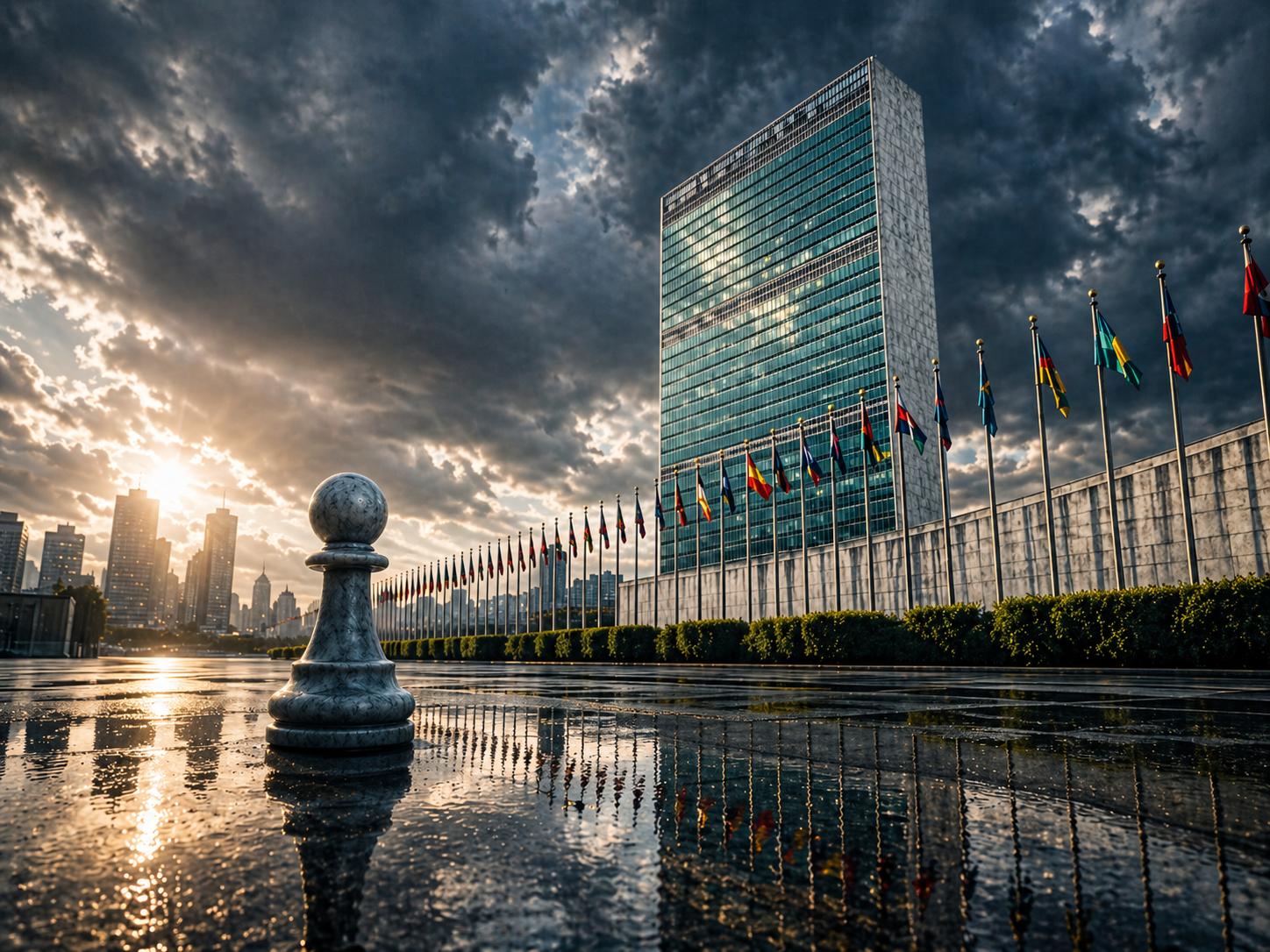
On 21 and 22 April 2026, four candidates for the position of United Nations Secretary-General appeared before the General Assembly in New York. For three hours each, they fielded questions from member states and civil society on everything from geopolitics and financial crisis to reform agendas and leadership philosophy. The dialogues were livestreamed, interpreted into all six official UN languages, and hailed by the General Assembly President as "a pivotal moment" in the selection process.
Between them, the four candidates carry the weight of two presidential terms, a decade of nuclear diplomacy, the stewardship of global trade and development, and the governance of a continent's political transition. By any reasonable measure of multilateral experience, the field is credentialled.
They were also, in a deeper sense, a performance of a paradox that nobody in the room named: the world was interviewing candidates for a job whose powers are undefined, whose tasks are uncodified, whose authority is structurally constrained by the very states conducting the interview, and whose accountability runs not to the eight billion people invoked in almost every answer, but to five governments holding a veto.
The problem with the search for the next Secretary-General is not the candidates, it's the job itself.
What the Charter Actually Says
The United Nations Charter, for all its ambition, devotes remarkably little space to defining the office at its center. The entire constitutional foundation of the Secretary-General's role rests on three articles:
Article 97: The Secretary-General shall be appointed by the General Assembly upon the recommendation of the Security Council. He shall be the chief administrative officer of the Organization.
Article 98: The Secretary-General shall act in that capacity in all meetings of the General Assembly, the Security Council, the Economic and Social Council, and the Trusteeship Council, and shall perform such other functions as are entrusted to him by these organs.
Article 99: The Secretary-General may bring to the attention of the Security Council any matter which in his opinion may threaten the maintenance of international peace and security.
That is, in its entirety, the constitutional job description. Chief administrative officer. Perform such functions as are entrusted by others. And one slender but consequential grant of independent initiative in Article 99: the discretionary power to place a matter on the Security Council's agenda.
The framers of the Charter were deliberate in their restraint. The great powers of 1945 wanted a chief administrator, not an independent political actor. They wanted someone who would service the machinery of intergovernmental decision-making, not someone who would drive it. The political dimensions of the role that the world now takes for granted — the moral voice, the good offices function, the role as global mediator and conscience, the convener of summits and guardian of norms — exist nowhere in that founding text.
They were built, piece by piece, by successive Secretaries-General willing to test the limits of what member states would tolerate. Dag Hammarskjöld stretched Article 99 into a doctrine of independent political action and paid for it with his life in the skies over Ndola. Kofi Annan claimed the moral authority to declare that state sovereignty could not shield governments from accountability for crimes against their own people. Each expansion of the role was contested, each tested the patience of the P5, and each left behind a precedent that is more fragile than it looks because it rests on political tolerance, not legal right.
The Architecture of Powerlessness
The gap between the Charter's text and the world's expectations is the source of a structural powerlessness that shapes everything the Secretary-General can and cannot do and it runs deeper than a legal curiosity.
Consider the Security Council. The body that is supposed to be the UN's primary instrument for maintaining international peace and security has been functionally paralyzed on the most consequential conflicts of the past decade. Gaza. Ukraine. Sudan. Myanmar. In each case, the veto — or its threat — has prevented the Council from acting. The Secretary-General has the power, under Article 99, to bring matters to the Council's attention. What the Secretary-General does not have is any power to make the Council act, any mechanism to bypass its paralysis, or any authority to substitute for its failure.
The same structural limitation applies across the institution. The Secretary-General cannot compel member states to pay their assessed contributions — a fact with immediate and severe consequences, since the UN currently faces a financial crisis that threatens its core operations. They cannot enforce General Assembly resolutions. They cannot require states to implement Security Council decisions. They can convene, facilitate, urge, appeal, and exhort. They cannot compel.
The original design produced this outcome and the pattern has a precedent that history has not been generous enough to make obvious. The League of Nations was given a mandate to prevent war and maintain collective security, and almost no power to enforce either. Its Covenant required unanimity among Council members for any substantive decision, which meant any state could effectively veto action against itself or its allies. When Japan marched into Manchuria in 1931 and Italy into Ethiopia in 1935, the League passed resolutions, imposed partial sanctions, and watched. The gap between what the institution declared and what it could compel destroyed its credibility within a decade of its founding. The first Secretary-General of the League, Sir Eric Drummond, drew his own conclusion from this architecture: he interpreted the role as purely administrative, scrupulously avoiding political positions, working entirely behind the scenes, never claiming independent moral authority. He understood the constraints with great clarity. He was perhaps too willing to accept them as permanent.
The United Nations was designed explicitly to correct the League's failure, with a Security Council granted real enforcement authority under Chapter VII. What its architects did not resolve — or perhaps could not, given the political realities of 1945 — was what would happen when the permanent members of that Council disagreed. The answer, as the past decade has made plain, is the same as the League's answer: resolutions, appeals, and watching. Gaza. Ukraine. Sudan. Myanmar. The veto, or its threat, has done to the UN what unanimity did to the League — not destroyed it outright, but hollowed it out at precisely the moments when it was most needed. There is also a thread that connects both institutions to the same country: the United States refused to join the League, fatally undermining it from birth, then became the principal architect of the UN. It is now the primary source of financial pressure on the UN system and the most significant contributor to Security Council paralysis on several of the defining crises of the era. The wheel has not come full circle. But it is turning.
What has changed, and changed dramatically, is the scale of what the world now expects the Secretary-General to deliver. Climate action. Pandemic response. Digital governance. Artificial intelligence oversight. The protection of civilians in active conflict. The prevention of nuclear escalation. Debt relief for the Global South. Gender equality. The Sustainable Development Goals. Civilizational challenges, every one of them, requiring binding commitments, enforcement mechanisms, and redistribution of power and resources on a scale the Charter's framers never contemplated, and the Charter's text never authorized.
The Accountability Vacuum
If the powers attached to the role are undefined and the tasks are uncodified, what does accountability even mean in this context? The question is not rhetorical. It goes to the heart of what has gone wrong with multilateral governance.
The formal accountability mechanism is clear in structure and deeply problematic in practice. The Secretary-General is appointed by the General Assembly on the recommendation of the Security Council, serves a five-year term renewable once, and can in theory be removed by the same process. In practice, this means the role's accountability runs structurally to the five permanent members of the Security Council. Their veto power over appointment and reappointment gives them leverage over the Secretary-General that no formal job description can counteract. A Secretary-General who offends a permanent member — even in the service of the Charter's principles — risks their second term. The incentive structure is unambiguous: institutional survival favours deference to the powerful.
The observation is structural, not personal. Every Secretary-General has navigated this constraint. Some have done so with greater courage than others. But the constraint itself has never been resolved, and the current selection process is not designed to resolve it. The interactive dialogues of April 2026 did not ask candidates how they would manage the tension between their accountability to the P5 and their claimed accountability to the world's peoples. The question was not posed because it has no comfortable answer.
Meanwhile, accountability to the 193 member states of the General Assembly is real but toothless. The Assembly can pass resolutions, hold debates, and make declarations. It cannot override the Security Council on matters of peace and security, cannot enforce its own resolutions, and has no effective mechanism for holding the Secretary-General to account for specific failures of action or judgment. And accountability to civil society and to the world's peoples — invoked constantly in the rhetoric of global governance — has no institutional mechanism at all. Civil society can ask questions in a dialogue. It cannot remove a Secretary-General who fails them.
The result is a role that is publicly accountable to everyone and structurally accountable to almost no one — except, decisively, to the five states whose veto determines the career.
The Gap Between Expectation and Mandate
There is a further dimension to this architecture that the April dialogues illustrated with uncomfortable clarity. The Secretary-General is simultaneously expected to perform roles that pull in opposite directions. And the Charter provides no guidance on how to navigate the contradictions.
As chief administrative officer, the Secretary-General must preserve institutional cohesion, manage a large and complex bureaucracy, and ensure the smooth functioning of a system that serves 193 member states with competing interests. This role demands prudence, consensus-building, and institutional loyalty.
As moral authority and spokesperson for the world's peoples, the Secretary-General must sometimes say what powerful states do not want to hear, name failures that institutions would prefer to obscure, and take positions that risk political cost. This role demands courage, independence, and a willingness to sacrifice institutional comfort for principled clarity.
As diplomatic broker, the Secretary-General must maintain equidistance between parties in conflict, preserve the trust of all sides, and avoid the appearance of partiality. This role demands studied neutrality.
As convener and norm-setter on emerging global challenges — artificial intelligence, digital governance, climate finance, pandemic preparedness — the Secretary-General must lead where no treaty framework yet exists, building political will for governance structures that states have not yet agreed to create. This role demands vision, risk-taking, and a comfort with authority that exceeds the formal mandate.
These four roles do not coexist easily. They pull in opposite directions. The administrator who preserves cohesion cannot always be the moral voice that challenges power. The neutral broker cannot always be the norm-setter who takes sides. And none of these roles is clearly defined in the Charter, which means the Secretary-General exercises them all at the sufferance of member states — who can, and do, object when the role expands in directions they dislike.
The candidates who appeared before the General Assembly in April 2026 were asked about all of these dimensions. They were not asked — because the question cannot be asked within the conventions of the process — how they would resolve the contradictions between them, or what they would do when the mandate runs out before the problem does.
What This Moment Actually Requires
The multilateral system built after 1945 rested on a set of shared assumptions: that states, however competitive, had a common interest in the rules of the game; that international law, however imperfect, constrained the strong as well as the weak; that institutions, however slow, were preferable to the alternatives. Those assumptions have been actively dismantled. By the system's enemies, yes, but also by some of its founding architects.
Into this environment steps the tenth Secretary-General, equipped with the constitutional tools of 1945, the administrative apparatus of a financially stressed international bureaucracy, and the moral authority that the role has accumulated — and that can be withdrawn when it becomes inconvenient. The gap between what the world needs and what the office can constitutionally deliver has never been wider.
This does not mean the role is without consequence. On the contrary: in conditions of institutional breakdown, individual leadership matters more, not less. A Secretary-General who understands the architecture of powerlessness, who does not pretend to authority they do not have, who builds coalitions of legitimacy that do not depend on P5 consensus, who speaks honestly about what the institution can and cannot deliver can do more with limited formal power than one who claims the full weight of the office and then cannot deliver on it.
But that kind of leadership requires something that the current selection process does not easily surface: a clear-eyed understanding of the structural constraints of the role, combined with the political imagination to work around them. It requires a candidate who has thought seriously about the nature of the office itself — its constitutional thinness, its accumulated precedents, its contradictory demands, and its fundamental dependence on the political tolerance of states that have their own interests to protect — as much as about what they would do within it.
Above all, it requires an orientation toward what the multilateral system must become. The world deserves a Secretary-General who understands why trust in collective governance has broken down, who can speak that truth without destroying what remains of the institution, and who is oriented — intellectually, politically, morally — toward the system's future rather than its past. Managing decline with grace and administrative competence is the floor, not the ceiling.
A Final Note on the Process Itself
The interactive dialogues of April 2026 were, by the standards of previous selection processes, genuinely transparent. Candidates presented vision statements, fielded three hours of questions, and engaged with civil society in ways that were livestreamed and publicly accessible. This is real progress from the opaque straw polls of an earlier era.
And yet the process remains, at its core, an intergovernmental negotiation among states with competing interests and a shared instinct to avoid the risk of the genuinely new. The final decision will be made not in the General Assembly chamber but in Security Council consultations where the P5 will seek a candidate they can all live with, which is a very different standard from the candidate the world's peoples most need. Diplomats familiar with the process speak openly of an "October surprise" — a dark horse candidate emerging from great-power bargaining shortly before the informal deadline.
The gap between the selection process and the leadership moment is, in this respect, a microcosm of the gap between the institution and its mandate. A system designed for intergovernmental consensus is being asked to identify the leader for a crisis of intergovernmental consensus. The paradox is structural.
None of this diminishes the importance of who is chosen. In conditions of institutional stress, character, judgment, and moral clarity matter enormously — precisely because they cannot be mandated by the Charter. But the world deserves to understand the constraints within which even the best Secretary-General will operate. The office is weaker than the rhetoric suggests, the mandate is narrower than the expectations demand, and the accountability is more distorted than the language of global governance acknowledges.
An honest conversation about what multilateral governance in the twenty-first century actually requires and what changes to architecture, mandate, and accountability would be needed to close the gap between the world's problems and the institution's capacity to address them is overdue and urgent. That conversation will not happen in the interactive dialogues. It needs to happen everywhere else.
And there remains a reason for hope, a slender but real one. The history of the office is also a history of individuals who refused to be contained by it. Hammarskjöld found in three spare articles of constitutional text the authority to act as the world's conscience. Annan claimed the moral ground to hold sovereignty accountable to human dignity. The Charter did not give them that power. They built it, through judgment, courage, and the accumulated trust of people who believed the institution could be more than it was written to be. The right Secretary-General has always had the capacity to rewrite the job in practice, to expand the mandate by living it differently, to rebuild trust by spending it honestly, to make the office larger than the document that created it. That possibility remains open. The question is whether the selection process, in its current form, is capable of ushering in the person who would seize it.
Simona Marinescu, Ph.D. is CEO of the IDCA Global Foundation, the non-profit digital equity arm of the International Data Center Authority, senior executive of the United Nations and a member of the Global Diplomatic Network. She writes on economics of vulnerability, digital governance, human capital development, and the intersection of technology and global policy.